English
Reading
At the Lantern, we want children to develop a love of literature which celebrates their literary heritage and the diverse world in which they live. We want children to be confident, fluent and enthusiastic readers who are able to engage with a wide range of texts. Our aim is to enable children to make the transition from learning to read to reading to learn.
Our Reading Model
We instill a love of reading through exploration of texts linked to all curriculum areas. The teaching of systematic synthetic phonics allows the children to be supported in becoming independent decoders and ultimately readers. From Year Three to Year Six, children are taught additional reading skills through discrete reading sessions, English lessons and through cross curricular reading opportunities.
Reading sessions take on the principles of a structure based on research and guidance from James Durran and high quality stimuli are chosen for the children to explore and enjoy. The structure allows children to be immersed within the taught texts.
- In addition to these taught reading sessions, reading is taught within each English unit of work linked to specific text types. These texts are carefully chosen to inspire and engage children. Reading skills are reinforced through English lessons.
- Every class has shared story time where picture books, novels poetry and non-fiction texts are enjoyed as a class. Children also have individual reading books and are encouraged to read every night at home. They are heard read individually in school as often as possible by teachers, teaching assistants and reading volunteers (including parents).
Throughout their time at the Lantern, children will experience additional reading experiences such as visits from authors and themed book weeks. We provide opportunities for children to purchase books through book sales and have an inviting and well-structured library system with rich and varied texts.
Writing
At the Lantern, we aim for children to be able to express themselves effectively through both the spoken and written word; children should grow as proficient communicators, who are able to adapt their writing for a wide range of purposes and audiences. We want to instil an enjoyment of language in young people, by enabling them to explore its patterns, structures and origins, allowing them to understand and make controlled writing choices to impact the reader.
The English curriculum is carefully mapped to ensure that all children have the opportunity to write across a range of text types which include a balance of fiction, non-fiction and poetry (which includes text types as broad as adventure narratives, to explanation texts, to formal speeches, to nonsense poems and much more). Units of work are based around high quality, engaging stimuli, and often link to the themed learning to allow children to make links in their learning and write across the curriculum. English Medium Term Plans ensure effective coverage and progression of text types. Prior to planning each unit of work, teachers follow a backward planning model, looking at the final intended outcomes and working back, considering the grammatical teaching points which should be incorporated into the unit of work. Grammar coverage for each year group is made explicit to teachers and the teaching is interwoven throughout the writing units so that children can understand its purpose in a context and use it in a controlled and creative manner.
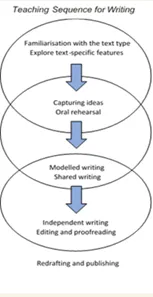
Sequence for Writing
Within each unit of work, teachers follow a clear sequence as a foundation for the learning process. They begin with text familiarisation, followed by capturing ideas and oral rehearsal. They then model and share writing before children write independently. Vocabulary development is a key feature of each unit and children are supported with this through the use of text-rich learning environments. Children are given frequent opportunities to edit, proofread and redraft their writing. In addition to this, speaking and listening opportunities are provided throughout all units of work to allow children to develop their oracy skills.
We teach handwriting based on the English Hub Progression model. In Reception, children should be encouraged to form letters individually before joining them together. This will ensure that children can form letters correctly, which will make joining them easier. Teachers should advise children when they are ready to join their handwriting. At the beginning of the year, handwriting should have a significant focus as it is essential that we set high expectations for presentation.
Handwriting
We aim for our pupils to develop a neat, legible, fluent handwriting style which enables them to communicate effectively in writing.
Children are ready to start forming letters when they can draw the following shapes.

It is important for children to develop a good pencil grip from the beginning.
When children start school, they learn to sit correctly at a desk with their feet flat on the floor and to hold a pencil using a tripod grip. This clip illustrates how to achieve the correct tripod pencil grip.
In their reception year, children are taught to form letters as they learn the sounds they represent. Letters are introduced in the same order as in the Little Wandle Phonics systematic synthetic phonics programme.
s a t i p n m d c k e u r h b j v w x y z q
In Year One, letter formation is taught in letter ‘families’. These are groups of letters which are formed in a similar way with the pencil moving in the same direction.
Curly caterpillar letters
c a o g d q e s f
Ladder letters
l i t u j y
Robot arm letters
r m n p b h k
Zig-zag letters
v w x z
In Year Two, children learn to form letters of the correct size relative to one another. They start to use the diagonal and horizontal strokes to join letters when appropriate.